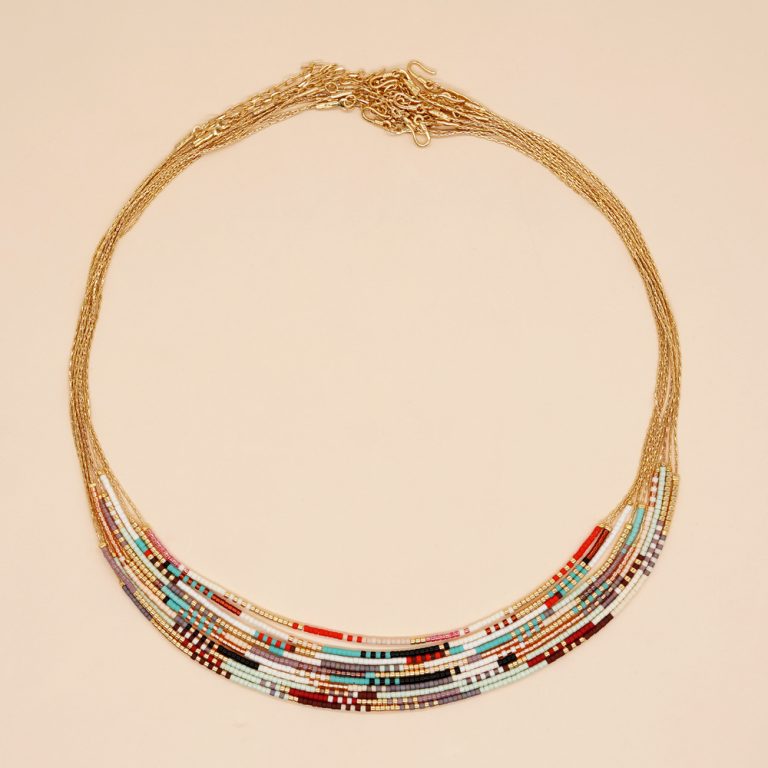
An order line that says “rainbow necklace” can refer to more than one finished look. A colorway is a particular arrangement of colors and components under a named product option. The red band might sit beside the pendant on one sample and farther up the beadwork on another. Both can be attractive. Only one matches the option a buyer signed off. Put the two coded pieces under the same light before deciding what the listing should say.
Start with the product codes
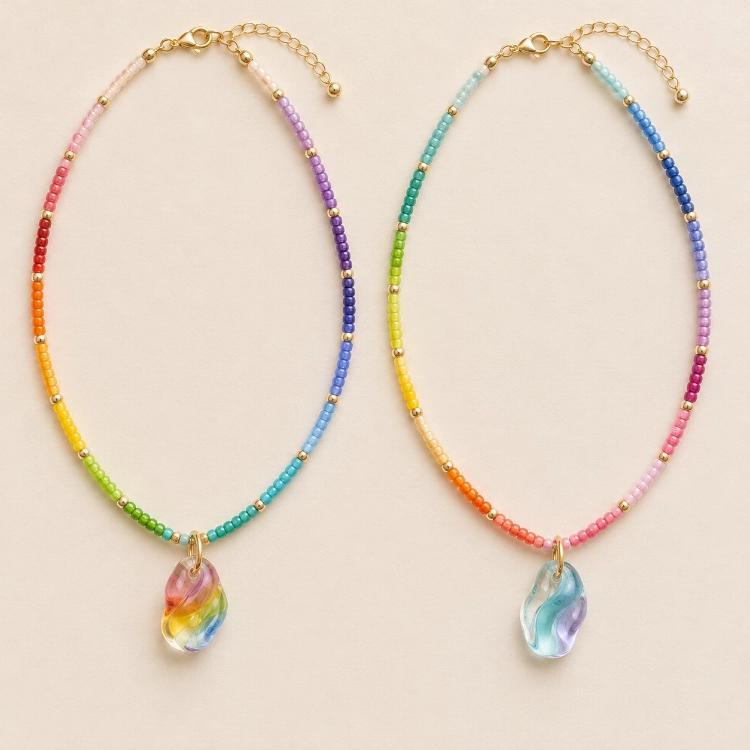
The Bohemian Style Rainbow Miyuki Bead Handmade Necklace gives a real example. LANCUI describes Miyuki DB beads, an organic glass pendant, geometric beadwork and an adjustable twisted link chain measuring 41–50 cm. Two option codes appear on the page: MI-N220071A and MI-N220071B. A code keeps an order distinct. It is no substitute for a front photograph of the actual necklace attached to that code.
Lay A and B beside their photographs. If the image filenames are generic, add the option codes to the shot list before any copy is written. Leave a coded card beside each sample during photography. The necklaces may look close enough that a file mix-up goes unnoticed until a customer selects a variant. A matching code on card, image and order line is a simple control that survives a change of photographer.
Record a variant, not a color impression
“Brighter” may be useful in a meeting. It will not tell a bead worker where the red section starts. Record the dominant hues in their actual order around the approved pendant, preferably with a marked front image. Record the pendant shape and chain finish separately. That distinction matters when only the bead colors change: the unchanged components can stay on the previous specification, while the new bead sequence gets its own revision.
Neither public option code supplies a bead-by-bead map. For a custom run, the approved piece or a marked drawing must carry that detail. A retailer should never reconstruct the pattern from a small web thumbnail and then call the reconstruction a factory specification. For example, a red band that appears to start at the pendant in a small image may actually begin one row back.
A useful sample card can be brief:
- Option code on the sample and its front image.
- Color-band order and the pendant used with that option.
- Chain finish and the setting used in the photograph.
Use a fair light for both options
Small beads make color comparisons unforgiving. A cream row can turn yellow under a warm desk lamp, while an organic glass pendant picks up reflections from the room. GIA’s jewelry photography guidance addresses light color and background choice. NIST’s discussion of color perception explains why the same object may appear different when the illumination changes.
The two necklaces should take turns in one marked position. Leave the lamps alone between shots. A neutral reference card in the setup frame helps the editor judge white balance later. If a large color correction is needed on only one option, check the capture before editing the beads. A buyer comparing the web images with the received samples will notice a mismatch long after the studio has forgotten how the lights were placed.
Photograph the same view twice
Hang both pendants at the same height for the front shots. A flat photograph of A beside a mannequin photograph of B makes even a matching chain look unlike itself. Shoot the full necklace, then move close enough to see the last bead before the pendant. GIA’s photo tips discuss controlling the light so a piece’s features remain clear. For the draped view, use the same form and camera position. The colors may bunch differently as the strands curve; that is worth showing, provided the comparison stays fair.
Set both chains to the same length before comparing pendant size. At the short end of the 41–50 cm range, the necklace sits higher and the colored portion appears tighter. At the long end it drops and opens out. The product page gives the range, but the shoot record should identify the setting used in each image. Otherwise a buyer might read a difference in fit as a difference between colorways. LANCUI’s product notes describe this as a lightweight necklace suited to casual dress, festivals and more formal outfits. Those styling contexts should not lead to a different color treatment for each option’s photograph.
Separate color variation from construction variation
Handwork does leave small differences. The question is whether the difference changes the design. A slightly uneven bead line may remain within the approved sample range; a missing color block, reversed sequence or off-center pendant may not. The decision belongs against the approved reference, with a note about what the buyer accepted. “Handmade variation” alone gives no boundary to the next batch.
Find the pendant attachment first. Follow the rows toward the chain on each side and compare where each color block begins and ends. An extra band on one side may be intentional; the drawing or named sample should settle it. Pay special attention to the join between beadwork and chain. A twist at that point can make an otherwise balanced pattern turn away from the viewer when the necklace hangs. Lift the sample after the flat check and see how it settles.
Where a retailer needs repeatable variants, the reference should be a sample and its photo set, not a social image after filters. Keep a note of allowed handmade variation if the design permits it. That note might concern bead placement or pendant appearance, but it should be specific enough to guide the next inspection. A vague “slight differences possible” line gives the production team very little to compare.
Put the right colorway in the listing
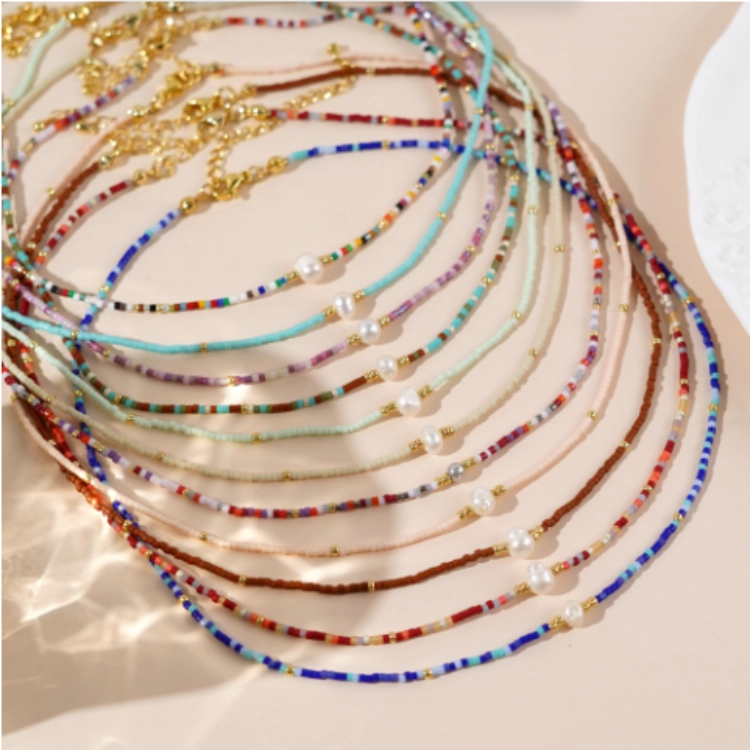
The option selector needs a name that matches the piece shipped under its code. A color nickname can sit beside the code; it cannot replace the code in the working record. Lead with the full front image and let the second image show the tiny beads and pendant. Shared chain copy is fine if both approved versions truly use that chain. If one version has a different finish or length, put the difference under that option so it is visible before purchase. For example, a variant photographed on a brass-colored chain should not inherit a stainless-steel description without a component check.
The FTC Jewelry Guides call for truthful representations of material, size, color, and other product characteristics. The FTC’s advertising FAQs also explain why ad claims need support. For a rainbow necklace, a listing image should not materially misstate the variant’s color. “Miyuki DB beads,” “organic glass pendant,” and “41–50 cm adjustable chain” should be used only for the style and version supported by the product record.
A concise product line might say: “Handmade geometric necklace with Miyuki DB beadwork, an organic glass pendant, and an adjustable twisted link chain.” The colorway label then names the option. A second line can clarify the range for the selected sample. This gives the buyer a description that can be checked against both the product and the image.
Use one approval set for the next order
The next order may use the same colors or adjust one. Keep the approved sample code, the design drawing, the front and detail images, and the component notes in one revision record. If a bead shade is replaced, record the substitute before production. A camera comparison alone cannot prove the bead supplier code; the material line has to do that work. The FTC Jewelry Guides provide the broader reason to keep the description of a revised item current.
LANCUI offers OEM work against a buyer’s established design and ODM development with trend research, prototyping, and sample review. Its inspection service covers incoming materials, production monitoring, and finished appearance, dimensions, and function. The colorway record gives those checks a concrete reference. Its photography and rendering services can support the listing images once the real sample is approved. LANCUI can discuss a variant request through its contact page when the buyer provides the code, sample photo, and exact proposed change. The company’s About Us page gives buyers background on the maker behind these services.
LANCUI has a market research team that follows global fashion and consumer preferences, while its design team turns a client’s brief into an accessory design. Its ODM process includes trend analysis, prototypes and sample development. That is relevant when a buyer wants a third rainbow arrangement rather than simply reordering A or B. A proposed new sequence can be reviewed on a physical prototype before the product photographs are made. LANCUI also lists product illustration, technical drawings, model photography and image post-processing among its support services. A drawing fixes the band order; the photography records what the approved beads actually look like under the chosen light.
Its ready-stock service covers handmade accessories held for quicker purchase, with flexible quantities for different buyers. That is a distinct route from developing a new colorway. LANCUI’s inspection service includes raw-material checks, monitoring during production, final inspection and reports with client feedback. A coded sample can be named in those records, so a color correction in an image is not mistaken for a change in the beads shipped.
For the final review, compare the two option pages side by side. Does each image show the matching bead order and pendant? Are both measured at the same chain setting? Does the filename or asset record identify the product code? A shopper should be able to choose between the colorways from the page without guessing which photograph belongs to which necklace.